Cómo llegamos aquí
Historia
Desde una pista en Acapulco hasta un circuito mundial — los hitos, con fotos y fuentes.
Este texto aún no está traducido a tu idioma, así que lees la versión en inglés.
1969
Acapulco, Mexico
Enrique Corcuera builds the first court in Acapulco
In 1969 the Mexican businessman Enrique Corcuera built a court at his house in Las Brisas: 20 metres by 10, closed in by walls about three metres high. There was no room for a full tennis court, and the walls stopped balls from disappearing into the undergrowth. One end backed onto the house itself. A ball that came off the wall stayed in play, and that single rule still separates padel from tennis.
They played with wooden paddles, first with squash balls and later with tennis balls. The game was called "Paddle Corcuera", and Corcuera's wife, Viviana, wrote down its first rules. The original court was demolished after he died in 1999. Its measurements survived. Every court you book today is the same 20 by 10 metres.
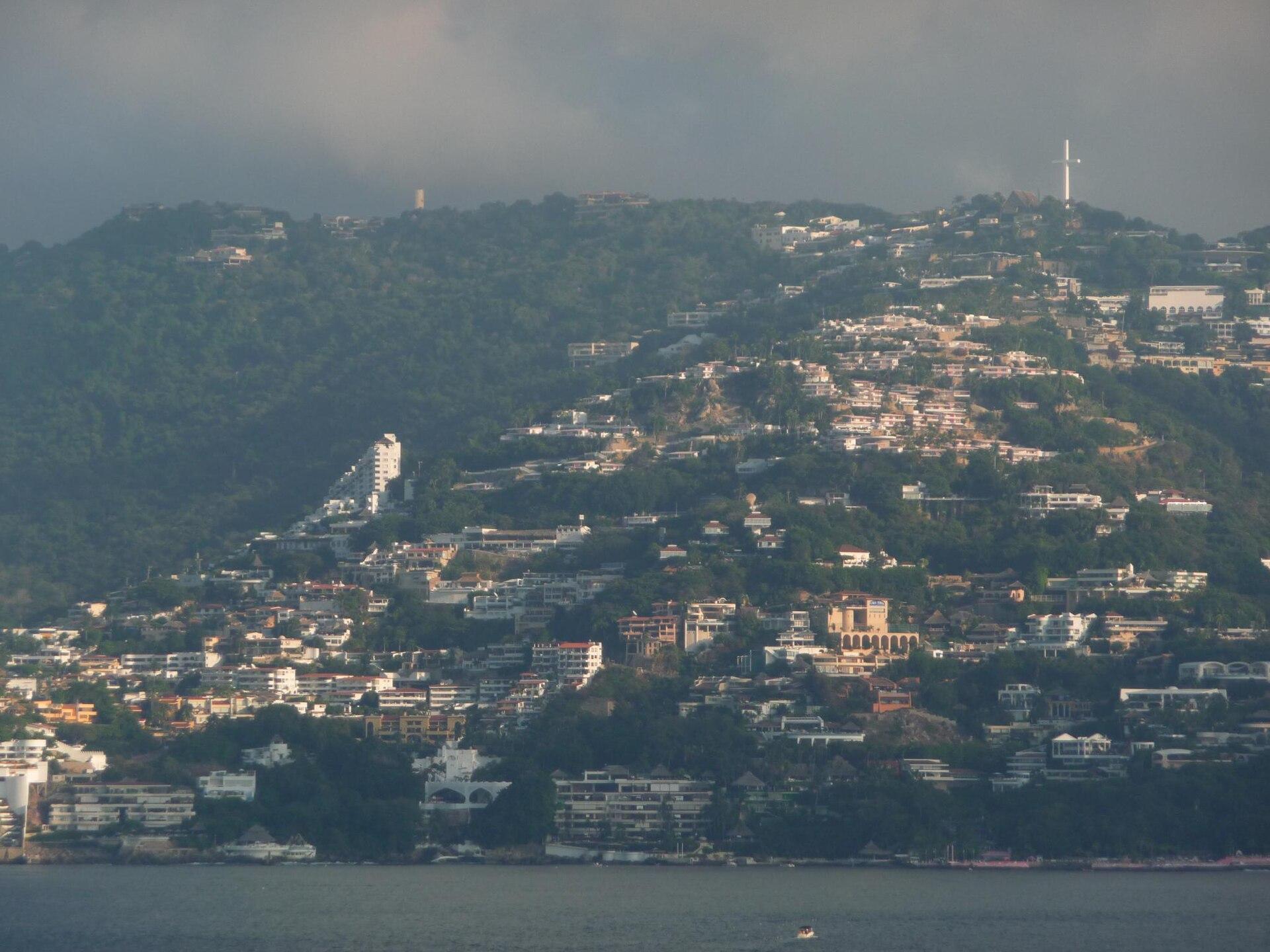
Hillside villas of the Las Brisas district above Acapulco Bay, photographed in 2009. Corcuera's house stood in this district; the first court no longer exists. — Foto: Wytze Koopal, CC BY 2.0 Fuentes: FIP: history of padel, La Nación: Enrique and Viviana Corcuera, BBC Mundo: how padel began, Wikipedia (es): Pádel
1974
Marbella, Spain
Alfonso de Hohenlohe takes the game to Marbella
Prince Alfonso de Hohenlohe played on Corcuera's court as a house guest in Acapulco and went home to Spain with a hand-drawn plan. In 1974 he built Spain's first two courts at his Marbella Club Hotel on the Costa del Sol. He did not copy the original exactly: wire mesh replaced part of the walls. That mix of solid wall and mesh is still on every court, and it is why a ball comes back true off one panel and skids unpredictably off the next.
The Spanish tennis player Manolo Santana promoted tournaments along the coast, and from Marbella the game moved into other Spanish clubs and then across the Atlantic.
Sources differ on the date. FIP says only "the early 1970s"; the LTA and the BBC, among others, give 1974.
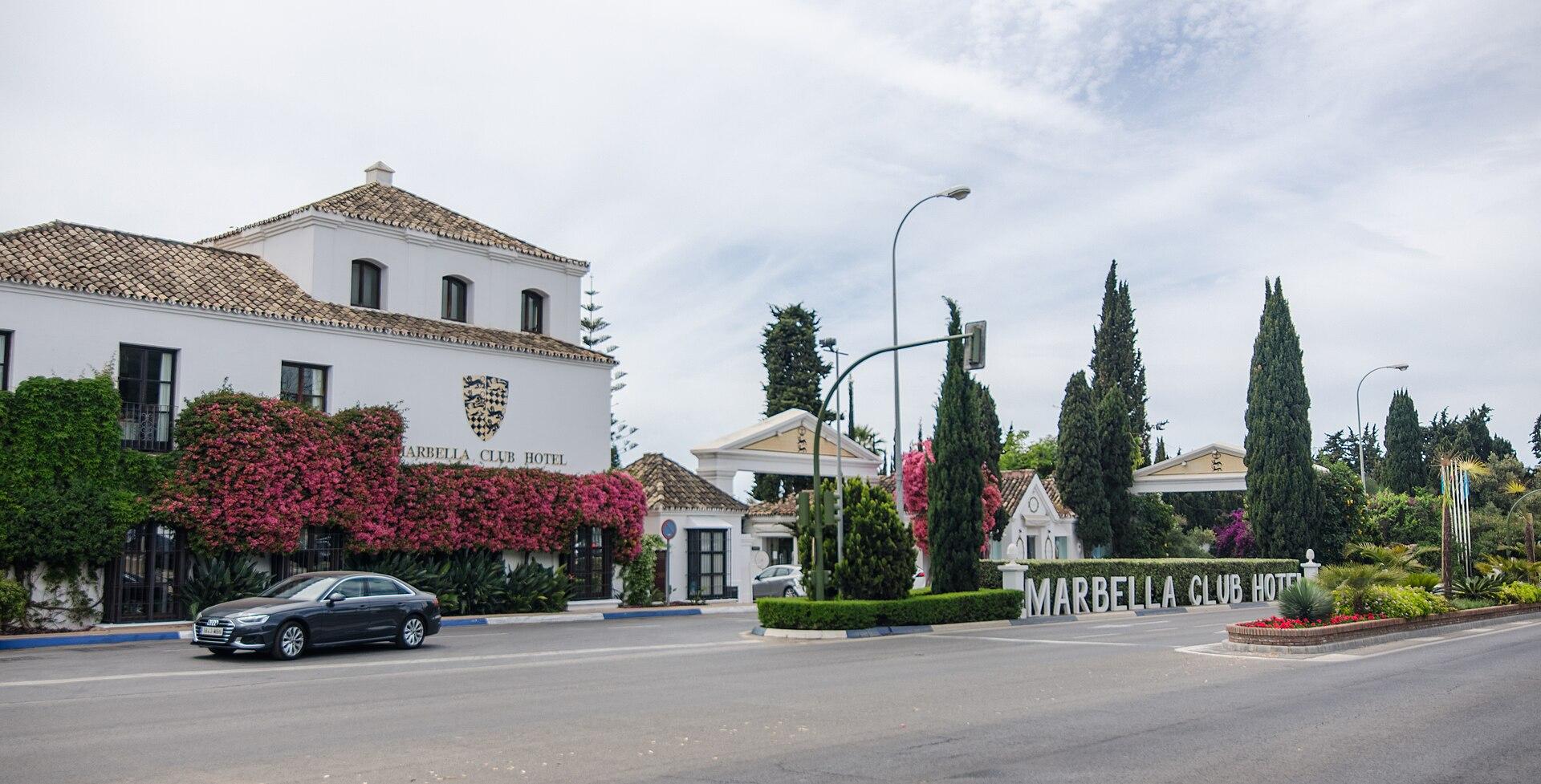
The entrance to the Marbella Club Hotel in Marbella, with the hotel's signs on either side, photographed in 2023. — Foto: Jeff Hitchcock, CC BY 2.0 Fuentes: FIP: history of padel, LTA Padel: the history of padel, BBC Mundo: how padel began, Wikipedia (en): Padel
1975
Argentina
Julio Menditeguy brings padel to Argentina
Julio Menditeguy, until then known as a polo player, brought padel to Argentina in 1975. FIP says he found the game at Hohenlohe's club in Marbella. Viviana Corcuera remembers it differently: he was a childhood friend of her husband and took the court's measurements straight from Acapulco. The first Argentine courts went up at Club Tortugas and at the Ocean Club in Mar del Plata, among other places.
By the early 1980s padel was a mass pastime in Argentina, and it went on to become the country's second most played sport. The results show it. Argentina won the first World Championship, and Fernando Belasteguín spent years as the professional world number one.
Some sources spell the name Menditegui or Menditengui. We use the spelling found in FIP's history and in La Nación.
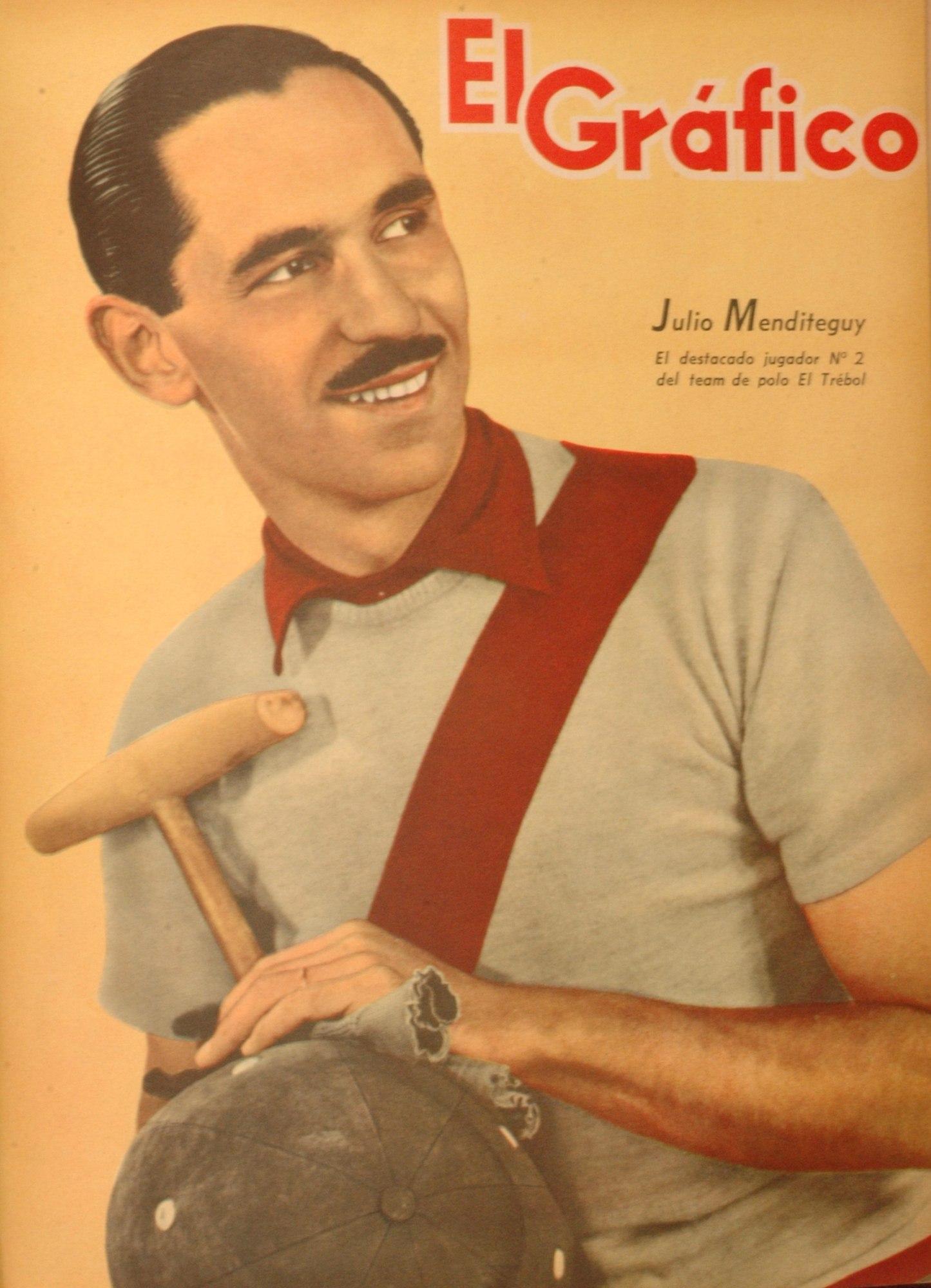
Cover of the Argentine weekly El Gráfico, 28 November 1941: Julio Menditeguy as a player for the El Trébol polo team, holding a polo mallet and helmet. — Foto: El Gráfico, Public domain Fuentes: FIP: history of padel, La Nación: Enrique and Viviana Corcuera, BBC Mundo: how padel began, Wikipedia (es): Pádel
1988–1989
Mar del Plata, Argentina
The first national association and the glass court
In January 1988 Mar del Plata staged the first international competition, Spain against Argentina. The Asociación Pádel Argentino was founded the same year. FIP counts it as the first national padel association anywhere.
The second change was to the court. The Argentine coach Jorge Galeotti built the "Crystal Palace", a glass-walled court that could be taken apart and moved. Solid walls hid the play. Glass let organisers put seats and cameras on every side and set a court down in an arena or a city square. Glass walls are now standard at tournaments and in clubs.
FIP dates the Crystal Palace to 1989. The Alborán has since found Galeotti's patent, which claims priority from 29 August 1991, and argues the court was first shown no earlier than that year.
Fuentes: FIP: history of padel, The Alborán: The First Glass Court, Wikipedia (es): Pádel
1991–1992
Madrid and Seville, Spain
FIP is founded and Argentina wins the first World Championship
On 12 July 1991 the associations of Argentina, Spain and Uruguay met in Madrid and founded the International Padel Federation (FIP). A sport that had grown separately in each country now had one body in charge of the rules and of national-team competition. FIP is based in Lausanne today.
Spain hosted the first World Championship a year later. Argentina beat the hosts 3–0 in both team finals, men's and women's. The pairs event, played in Seville in September 1992, went to the Argentines Alejandro Lasaigues and Roberto Gattiker.
The championship has been held every two years since. The balance of power from that first edition has barely moved: the team titles almost always go to Argentina or Spain.
Fuentes: FIP: history of padel, Wikipedia (en): International Padel Federation, Wikipedia (en): Padel World Championship, BBC Mundo: how padel began
1993–1997
Madrid and Barcelona, Spain
Spain recognises padel and the rules are unified
In May 1993 Spain's national sports council, the Consejo Superior de Deportes, recognised padel as a sport. The Spanish spelling "pádel" settled in at the same time. On 24 January 1997 the council approved the Spanish Padel Federation, which put padel inside Spain's official sports system on the same footing as other disciplines.
Later that year Spain and Argentina agreed in Barcelona on a single set of rules and a single name: "padel", in place of the "paddle" used in Argentina. By the end of the decade FIP had 11 national federations.
The effect on anyone starting now is simple. The rules you learn in Warsaw or Wrocław are the ones played in Buenos Aires and Madrid.
Fuentes: Federación Madrileña de Pádel: history, El País, 25 January 1997, FIP: history of padel, LTA Padel: the history of padel
2005
Spain
Padel Pro Tour: the professionals get one circuit
Padel Pro Tour was set up in 2005 by tournament organisers together with the players' association AJPP and the women's association AFEP. Its first season was 2006 and its last 2012. Professional tournaments became a single circuit with a shared ranking. In 2010 that meant 17 events in Spain, three in Argentina and a season-ending Master in Madrid.
One pair owned those years: Juan Martín Díaz and Fernando Belasteguín, ranked number one season after season.
Padel Pro Tour also fixed the format every later tour has kept: a season of tournaments, ranking points, and a finals event for the best. If you follow Premier Padel now, you are watching the same model at a larger scale.
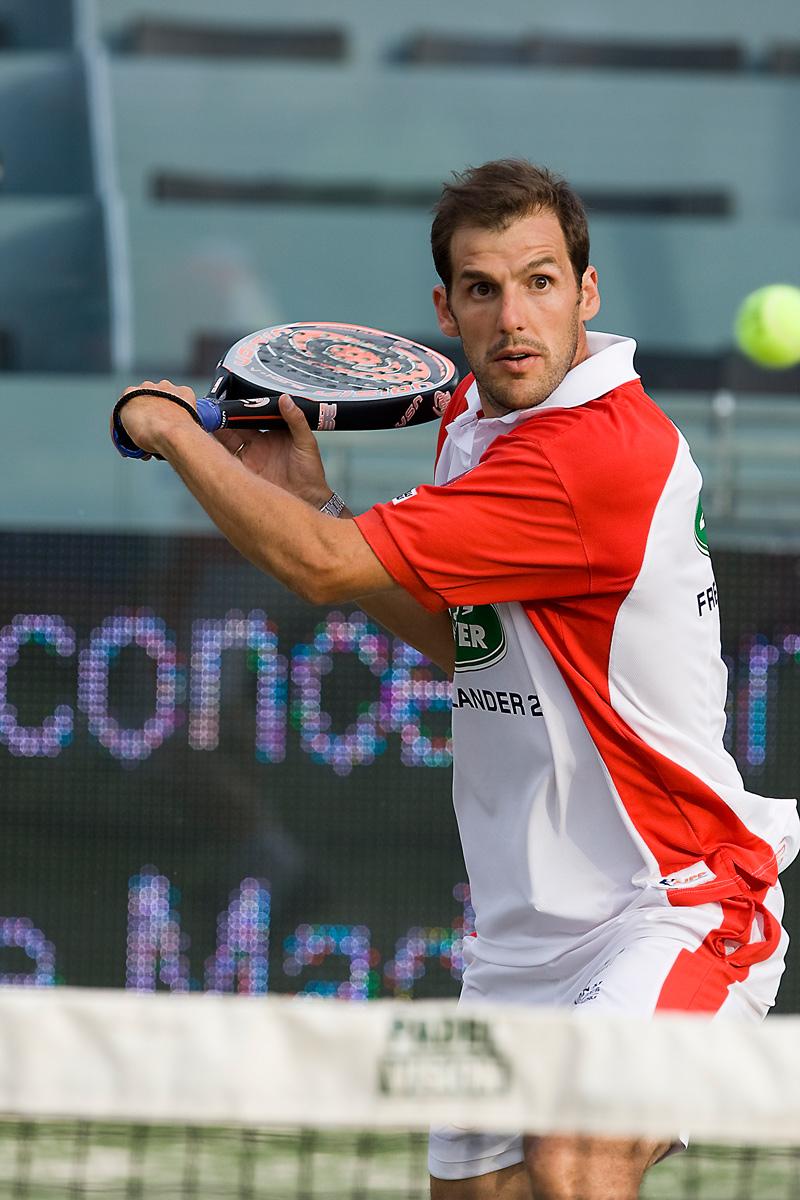
Juan Martín Díaz hits a backhand at a Padel Pro Tour event in Madrid in 2008; the tour's logo is visible on the net band. — Foto: Mediobarco, CC BY 3.0 Fuentes: Wikipedia (es): Pádel Pro Tour, FIP: history of padel, Wikipedia (en): Padel
2012–2017
Warsaw, Poland
The first courts in Poland
Poland's first padel court opened in 2012 at Sinus Sport Club in Wilanów, a district of Warsaw. The man behind it, Marcin Potrzebowski, had first heard of the game two years earlier at a trade fair in Germany. In March 2016 Kielce got the country's first indoor court. In the Polish climate, a roof is what turns padel into a year-round sport.
The Polish Padel Federation (Polska Federacja Padla) was founded in 2017, according to Przegląd Sportowy and Vogue Polska. The name was already in use a year earlier, in a post from April 2016 on the federation's own site. Also in 2017, Poland's national team made its debut at the European Championships in Portugal.
For a sense of scale: in May 2025 Vogue Polska put the number of courts in Poland at about 200.
Fuentes: Vogue Polska: Padel podbija Polskę (22 May 2025), Przegląd Sportowy Onet: Rozłam na korcie, Polska Federacja Padla: Pierwszy w Polsce turniej padlowy (12 April 2016), Wikipedia (pl): Padel
2013
Spain
World Padel Tour replaces Padel Pro Tour
In 2012 the top 100 players signed with a new circuit, World Padel Tour, run by the Madrid company Setpoint Events, part of the Damm group. Its first tournament was played in April 2013. Padel Pro Tour went to court to stop its rival, and on 15 April 2013 a Madrid court refused to suspend the new tour.
WPT ran for eleven seasons, the last in 2023. A year meant 15 to 25 tournaments plus a Master Final for the top 16 men and women, and the final season visited 14 countries. Fernando Belasteguín finished every year from 2013 to 2017 as number one.
In 2020 WPT brought in the golden point: at 40–40 a single point decides the game, with no advantage played.
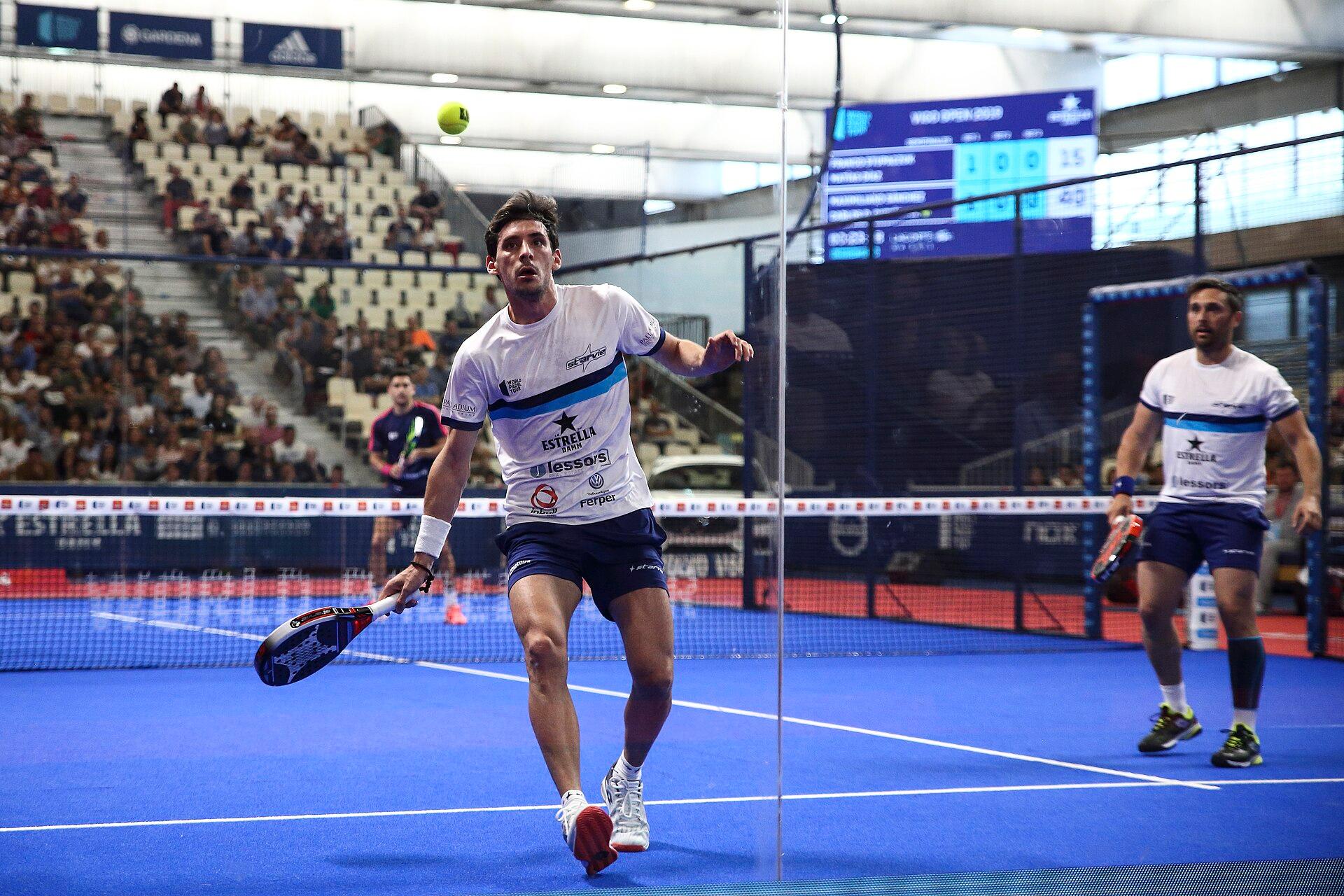
A match at the World Padel Tour Vigo Open 2019: one player runs to the ball near the glass wall while his partner waits behind, with the crowd and scoreboard in the background. — Foto: Harpagornis, CC BY-SA 4.0 Fuentes: Wikipedia (en): World Padel Tour, Wikipedia (es): Pádel, FIP: history of padel
2022
Doha, Qatar
Premier Padel starts in Doha
Early in 2022 FIP announced a professional tour of its own, built with Qatar Sports Investments (QSI) and the players' association, the PPA. It was named Premier Padel. The first event, the Qatar Major, was played in Doha from 28 March to 2 April 2022. It drew 123 registered pairs from 19 countries, and the winners took 2,000 ranking points.
The first season had eight tournaments, including Majors in Paris, on the courts of Roland-Garros, and in Rome. World Padel Tour sued the players. FIP and the players filed a complaint against Setpoint with the European Commission. For two seasons the best pairs played both tours side by side.
The argument was about who sets the calendar and shares out the money: a private promoter, or the federation together with the players.
Fuentes: The Peninsula Qatar, 28 March 2022, Wikipedia (en): Premier Padel, FIP: history of padel
2023
Kraków, Poland
Padel makes its European Games debut in Kraków
From 21 to 25 June 2023 padel was a medal sport at a major multi-sport Games for the first time: the European Games Kraków-Małopolska. Early rounds were played at the Krakowski Szkolny Ośrodek Sportowy courts. The semi-finals and finals moved to a temporary court on the Main Square, next to the Cloth Hall.
Spain's Noa Cánovas and Daniel Santigosa won the mixed doubles. Italy's Carolina Orsi and Giorgia Marchetti took the women's title, and Santigosa won the men's with David Gala. For Poland, Aleksandra Rosolska and Jerzy Janowicz reached the mixed quarter-final and lost 3–6, 5–7 to a Spanish pair.
Kraków opened the door to other Games. In 2026 padel medals were awarded at the Mediterranean, South American and Asian Games, and the sport returns to the European Games in Istanbul in 2027.
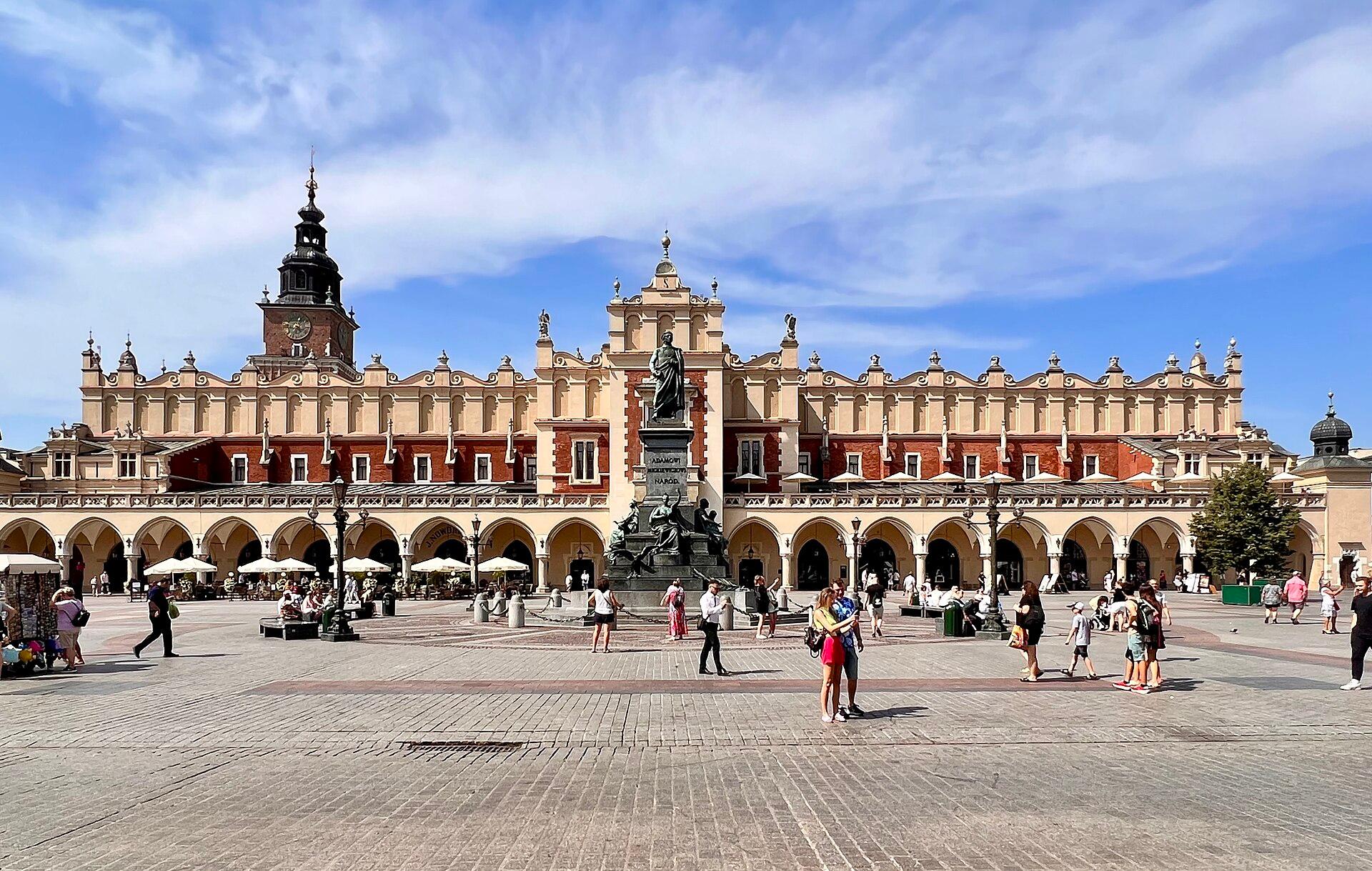
The Cloth Hall (Sukiennice) and the Adam Mickiewicz monument on Kraków's Main Square, August 2023. Two months earlier a temporary court stood here for the semi-finals and finals of the Games; it is no longer there in this photo. — Foto: Chris Olszewski, CC BY-SA 4.0 Fuentes: FIP / European Olympic Committees: The stage for padel’s major multi-sport debut, Radio Kraków: padel at the European Games, TVP Sport: Rosolska and Janowicz out in the mixed quarter-final, Wikipedia (en): Padel at the 2023 European Games, Inside the Games, 22 October 2026
2023–2024
Doha and Barcelona
One tour: Premier Padel absorbs World Padel Tour
On 24 August 2023 QSI and the Damm group announced a deal. The Qatari fund would buy World Padel Tour, and the two circuits would merge into one, Premier Padel, under FIP's governance. The legal disputes were settled. World Padel Tour played out its 2023 season and left the calendar.
In 2024, after two years of a split tour, the players had a single calendar again. The season ran to 24 tournaments in 16 countries, graded Major, P1 and P2, and ended in December with the finals at the Palau Sant Jordi in Barcelona.
For a fan the change is easy to describe. You no longer need to follow two rival circuits to know who is number one. The FIP ranking tells you.
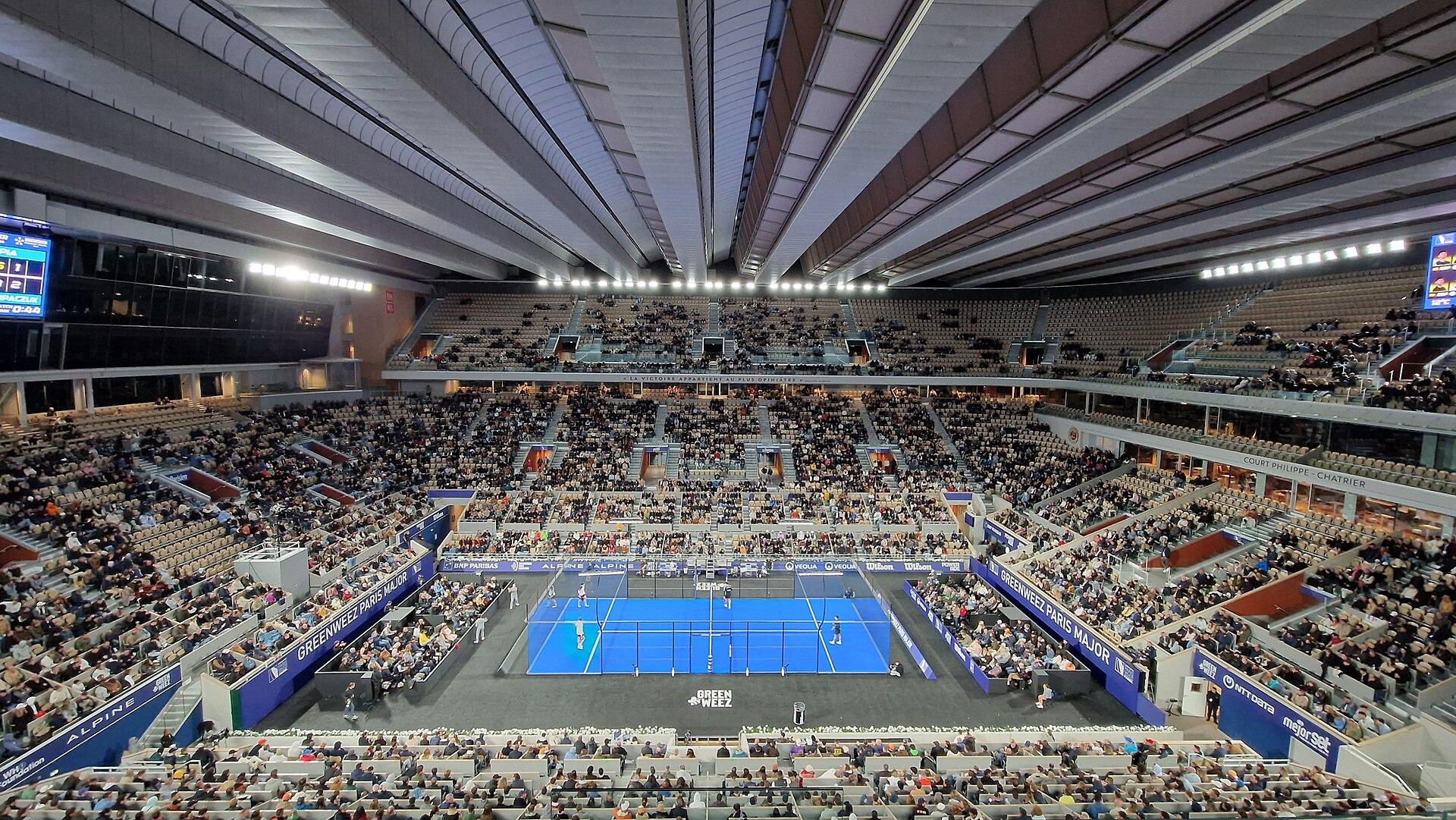
A blue padel court set up on Court Philippe-Chatrier at Roland-Garros during the Paris Major 2024, with the roof closed and the stands full. — Foto: Hombrey, CC0 Fuentes: FIP: QSI and Damm agreement, 24 August 2023, Premier Padel: first half of 2024 review, Wikipedia (en): Premier Padel, FIP: history of padel
2025–2026
Warsaw, Poland
Two Polish bodies and an agreement to merge
On 12 December 2025 six clubs, including Warsaw Padel Club, Interpadel and Pura Padel, founded the Polski Związek Padla (Polish Padel Association). The older Polska Federacja Padla kept its FIP membership and the national teams, but Poland now had two governing bodies, and each planned its own national championship for 2026. In February 2026 the Federation elected a new board, with Marcin Nowak as president and Jerzy Janowicz as vice-president.
In late August 2026 the two sides signed an agreement in Warsaw, at the Museum of Sport and Tourism, to merge under the name Polska Federacja Padla. Actu Padel reported that on 29 October the court register (KRS) did not yet show the enlarged board.
In spring 2026 padel still had no federation recognised under Poland's Sports Act. The gain for players is practical: one national championship, not two.
Fuentes: Polski Związek Padla: statement, Przegląd Sportowy Onet: Rozłam na korcie, Padelnet: Polska Federacja Padla i Polski Związek Padla łączą siły, SportMarketing.pl: Polska Federacja Padla i Polski Związek Padla łączą siły, Actu Padel: Polish padel reunification (29 October 2026)
2026
Nagoya, Japan
Star Point, the Asian Games and the Brisbane 2032 question
The 2026 season opened with a change to scoring. FIP's general assembly voted unanimously for the Star Point option: at deuce you play advantage, but only twice. A third deuce is settled by one deciding point. Premier Padel has used it since the Riyadh tournament in February.
From 28 September to 3 October padel was a medal sport at the Asian Games for the first time, at Aichi-Nagoya. Japan's Saki Tsukamoto and Kae Tokumoto won the women's gold. The brothers Mashari and Rashed Naif won the men's for Qatar.
On 20 October FIP, which now has 100 member federations, renewed its campaign for a place at the Brisbane 2032 Olympics. FIP is not a member of the association of IOC-recognised federations, and the IOC has made no decision.
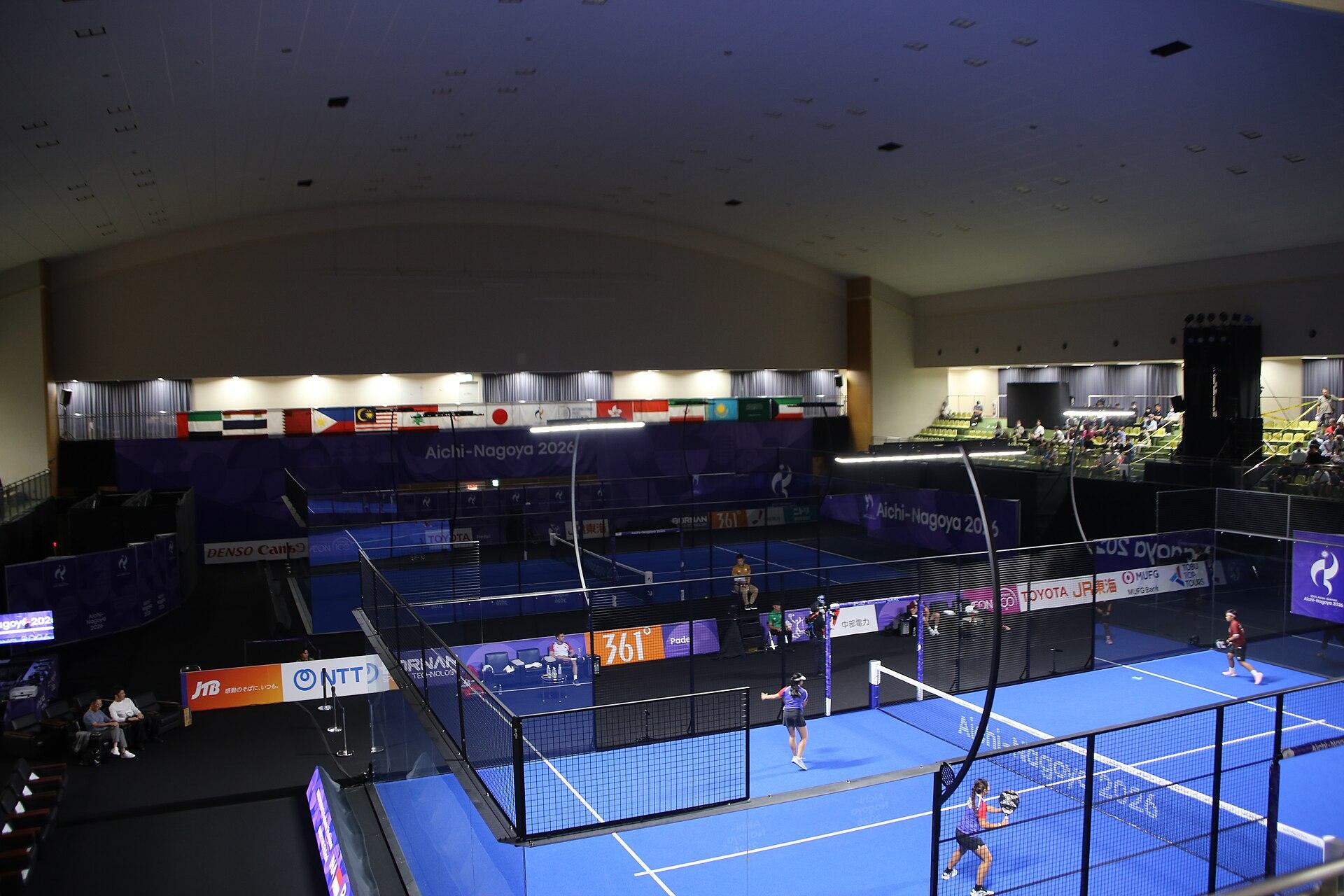
Nagoya City Higashi Sports Center during the padel tournament of the Aichi-Nagoya Asian Games, 2 October 2026: a blue court with a match in progress and the flags of the competing nations. — Foto: 円周率3パーセント, CC BY-SA 4.0 Fuentes: FIP: introducing the Star Point, FIP: Japan and Qatar win gold at the Asian Games, Wikipedia (en): Padel at the 2026 Asian Games, Inside the Games, 22 October 2026, FIP: history of padel